Product Spotlight — Neousys
Neousys POC-900: Maximum Performance in Minimal DIN-Rail Space
Ultra-compact DIN-rail embedded computer powered by AMD Ryzen PRO 8640U with integrated 16 TOPs AI NPU, delivering 2.7x the performance of previous POC models in the same 64×116×176mm footprint. Ideal for space-constrained industrial automation and edge AI applications.

The Neousys POC-900 packs AMD Ryzen PRO 8640U and a 16 TOPs AI NPU into a 64×116×176mm fanless chassis, delivering 2.7x the performance of previous POC models. With four PoE+ ports, MezIO modular expansion, and -25°C to 70°C operation, it’s purpose-built for modernizing industrial automation and edge AI in space-constrained control cabinets.
Finding powerful computing that fits in a control cabinet gets harder every year. As industrial applications demand more processing power, AI capabilities, and connectivity options, the physical constraints of DIN-rail mounting haven't changed. The newly unveiled Neousys POC-900 addresses this challenge head-on, packing AMD's latest Ryzen PRO processor with integrated AI acceleration into the same ultra-compact form factor that made the POC series successful. For engineers working with crowded control panels or mobile equipment with severe space limitations, this represents a significant opportunity to modernize without redesigning enclosures.
What Makes the POC-900 Different
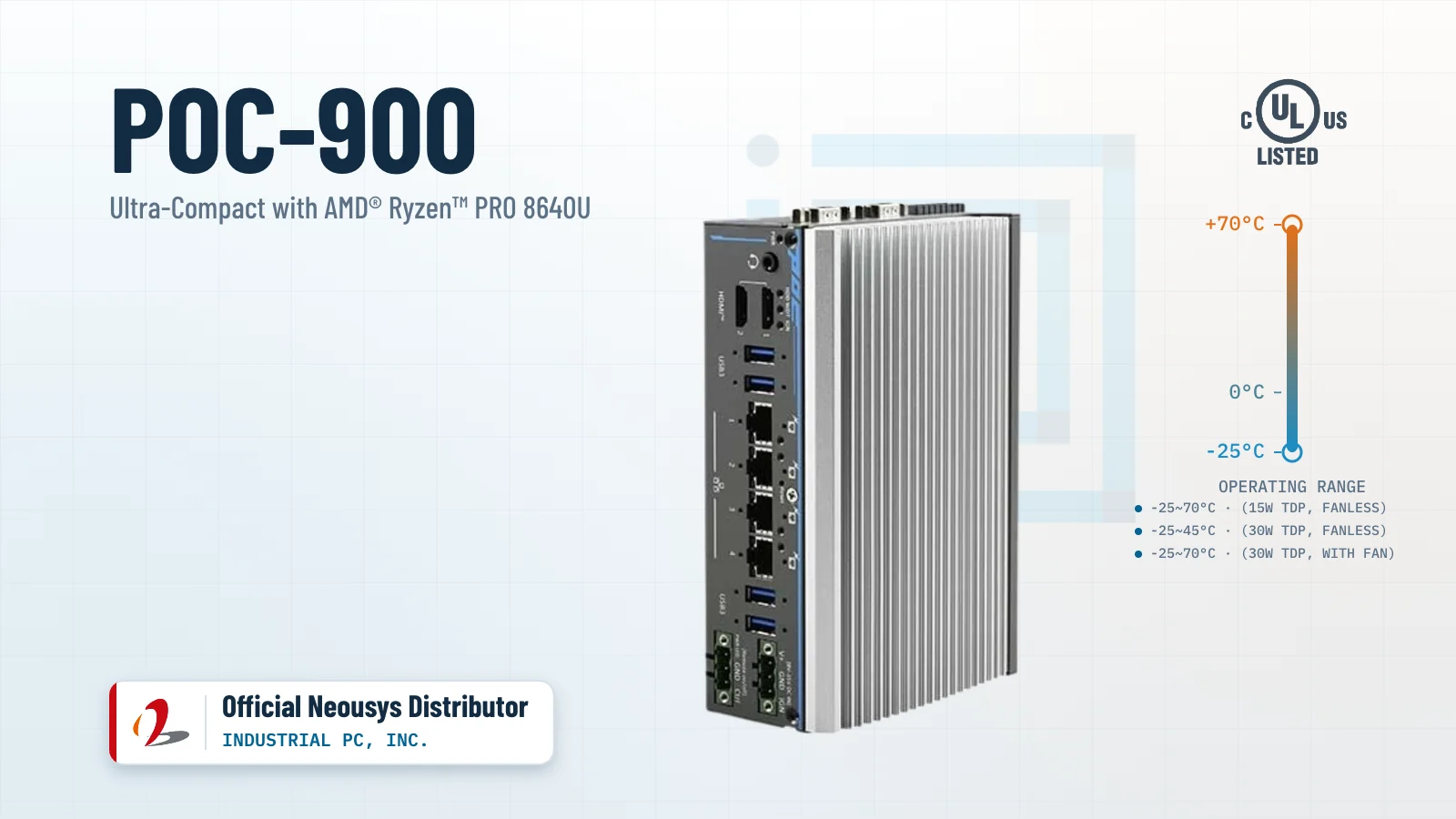
The POC-900 fundamentally changes what's possible in a DIN-rail mounted computer. While previous generations focused on basic control and communication tasks, this new model brings edge AI processing and workstation-class performance to spaces where traditional computers simply won't fit.
AMD Ryzen PRO Power in Industrial Packaging
At the heart of the POC-900 sits the AMD Ryzen PRO 8640U processor, featuring 6 cores and 12 threads running at up to 4.9 GHz. This isn't just another incremental processor update. Compared to the POC-500 series, you're looking at 2.7 times the raw computing performance. That means applications that previously required multiple systems or external processing can now run on a single DIN-rail unit.
The integrated AMD Radeon RDNA3 graphics handle visualization tasks that would have required discrete graphics cards in previous generations. For HMI applications, data visualization dashboards, or even basic machine vision preprocessing, the integrated graphics provide sufficient performance without adding complexity or power consumption.
Memory support extends to 32GB of DDR5-5600 through a single SODIMM socket. While some might prefer dual-channel memory for maximum bandwidth, the single-socket design makes sense here. It simplifies the internal layout, reduces heat generation, and maintains the ultra-compact dimensions that define this product category.
Technical Note: DDR5 memory offers up to 40% more bandwidth than previous DDR4-based POC models, enhancing performance for data-intensive workloads.
Integrated AI Without External Accelerators
The standout feature is the integrated Ryzen AI NPU delivering 16 TOPs of dedicated AI performance. This isn't marketing fluff about "AI-ready" systems. The NPU handles real inference workloads for quality inspection, predictive maintenance, and intelligent automation directly on the device.
- Images sent to remote server for inference
- Network latency: 50–200ms per decision
- Dependent on reliable connectivity
- Higher security and privacy risks
- Inference runs locally on NPU
- Real-time decisions, minimal latency
- No dependency on cloud/network
- Data stays on-premises
The AI capabilities also enable new applications that weren't practical with previous POC generations. Predictive maintenance algorithms can run continuously, analyzing vibration patterns or thermal signatures to identify potential failures before they occur. Natural language processing for voice-controlled interfaces becomes feasible. Even complex computer vision tasks like object detection and classification run smoothly.
Connectivity Designed for Industrial Networks
Four Gigabit Ethernet ports with PoE+ support set the POC-900 apart from typical embedded computers. Each port can deliver up to 30W to connected devices, eliminating separate power supplies for IP cameras, sensors, or wireless access points. For a machine vision system with multiple cameras, this dramatically simplifies wiring and reduces installation costs.
Tip: PoE+ ports supply up to 30W each—enough for most industrial cameras and access points, reducing the need for external power adapters.
Thermal Design and Environmental Resilience
Industrial computers face temperature extremes that would destroy consumer hardware. The POC-900 operates reliably from -25°C to 70°C, but the thermal design goes beyond simple temperature ratings.
- Silent, dustproof operation
- Passive cooling via aluminum chassis
- -25°C to 70°C ambient
- Most reliable for 24/7 use
- Higher sustained performance
- Fan activates only as needed
- Same -25°C to 70°C range
- For compute-heavy workloads
Cold-start capability deserves special mention. Many industrial computers rated for -25°C operation struggle to boot at these temperatures. The POC-900 includes specialized firmware that manages the boot sequence at extreme temperatures, ensuring reliable cold starts even in outdoor installations or refrigerated environments.
Technical Note: The fanless design eliminates moving parts—the #1 failure point in industrial PCs—while the DIN-rail mounting and locking connectors ensure secure operation in high-vibration environments.
How to Deploy the POC-900 Effectively
Successful POC-900 deployment starts with understanding your specific requirements and matching them to the system's capabilities.
Info: The MezIO expansion interface provides flexibility for unique requirements. Add serial ports, CAN bus, or custom I/O as your application evolves—without replacing the base unit.
Key Takeaways
Frequently Asked Questions
Need Help Selecting the Right Industrial Computer?
Ready to modernize your DIN-rail computing without redesigning your control cabinets? Dan and our team will help you determine if the POC-900’s combination of processing power, AI acceleration, and industrial connectivity matches your needs—or recommend the best-fit platform for your application.
Talk to an Engineer →