Passive Cooling
Industrial Computers
A passively cooled industrial computer is a PC that uses a fanless design to dissipate heat. Instead of relying on a mechanical fan to draw in cool air (along with dust, debris, and moisture), it uses a method called conduction.

President, Industrial PC
Last Updated: November 3, 2025

Passive Cooling
Industrial Computers
A passively cooled industrial computer is a PC that uses a fanless design to dissipate heat. Instead of relying on a mechanical fan to draw in cool air (along with dust, debris, and moisture), it uses a method called conduction.
President, Industrial PC
Last Updated: November 3, 2025
The US Leader in Passively Cooled Industrial Computers Since 1996
Passive cooled industrial embedded computers are engineered for ultimate reliability in environments where standard computers would quickly fail. By eliminating the single most common point of failure (the cooling fan), passively cooled industrial computers deliver unmatched durability and performance.

Popular Fanless Industrial Computers


What is a Passively Cooled Industrial Computer?
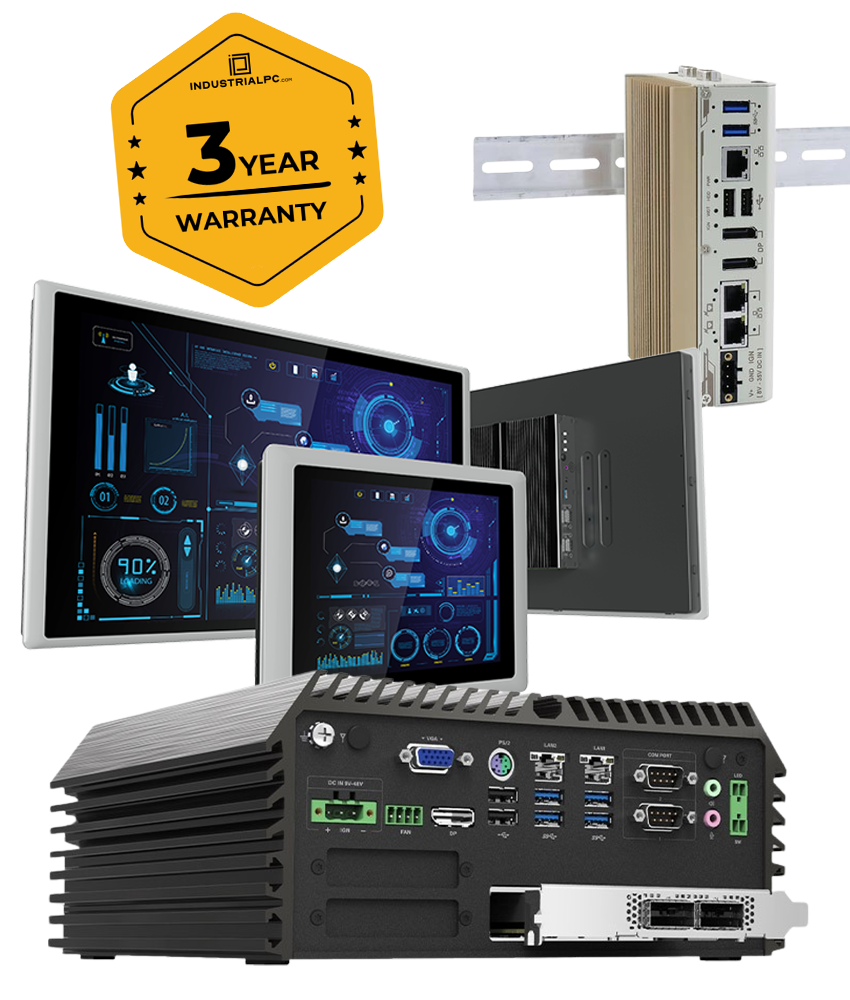
The Advantages of Passive Cooling
Unmatched Reliability
Zero moving parts means a drastic reduction in failure points. Fans clog with dust, their bearings wear out, and they eventually fail, leading to system overheating and costly downtime. Passively cooled PCs are built for 24/7, set-and-forget operation.
Superior Durability in Harsh Environments
Because there are no vents or openings needed for a fan, passively cooled computers feature a fully sealed enclosure. This makes them highly resistant to common industrial hazards:
- Dust and Debris: Ideal for dusty environments like manufacturing floors, woodworking shops, or agricultural settings.
- Moisture and Splashes: Can be deployed in locations with high humidity or exposure to liquids.
- Vibration and Shock: The solid-state construction makes them incredibly resistant to the constant vibrations found in vehicles, heavy machinery, and production lines.
Silent Operation
With no fan, these computers are completely silent. This makes them the perfect choice for noise-sensitive environments such as recording studios, medical facilities, control rooms, and in-vehicle applications.
Compact and Flexible Design
The fanless design allows for more compact and versatile form factors. These embedded systems can be mounted in tight spaces where traditional computers simply won’t fit, such as inside machinery, kiosks, or digital signage displays.
When Passive Cooling isn’t Enough

Industrial PCs are built for the harshest environments, and a key feature is their fanless heat sink design, which provides passive cooling. This rugged design expertly wicks heat away, enabling the embedded computer to reliably withstand extreme temperatures and operate 24/7 without fail.
While this passive cooling system is essential, it isn’t a silver bullet. The performance and longevity of your Industrial PC depend on every single component inside. Using off-the-shelf, commercial-grade parts—like inexpensive memory or storage with low heat tolerance—can create a critical weak point. If an internal component doesn’t have the same high heat capacity as the rest of the system, it will overheat and fail, regardless of how effective the fanless chassis is.
Don’t let cheap parts compromise your mission-critical application. To guarantee a system that truly can handle the heat, you need industrial-grade components expertly matched to the thermal design.

In other scenarios, these industrial PCs can be configured with such a side variety of processors and an almost infinite number of possible expansion cards and modules, sometimes additional active cooling may be required.
For example, the DS-1400 Series is inherently designed for fanless operation; there is simply not enough room for enough fan-based cooling in these very compact industrial PCs. However, unlike fixed, non-expandable systems with known thermal loads, DS-1400 Series systems are highly customizable.
This image shows a DS-1400 with a high performance Intel Core i9 processor, as well as a NVIDIA GeForce GTX 1630 graphics card. That meant a big booster fan on top of the heatsink as well as an internal fan and the fans that’s part of the GTX 1630 card.
TIP: When building your computer, each section allows you to select one option, multiple options, or no option if you’re unsure. Fill out as little or as much information as you know and we’ll take it from there!
LET’S BUILD AN INDUSTRIAL PC TOGETHER
TELL US YOUR INDUSTRIAL PC REQUIREMENTS
TIP: When building your quote below, each section allows you to select one option, multiple options, or no option if you’re unsure. Fill out as little or as much information as you know and we’ll take it from there!