Wide Temperature Industrial PCs
| Type | Industrial computer |
|---|---|
| Common operating ranges | −20 °C to 60 °C; −25 °C to 70 °C; −40 °C to 70 °C |
| Typical office PC | About 10 °C to 35 °C |
| Component grades | Commercial: 0 °C to 70 °C Industrial: −40 °C to 85 °C |
| Typical cooling | Fanless conduction through the chassis |
| Test methods | IEC 60068-2-1, -2-2, -2-14; MIL-STD-810 Methods 501 and 502 |
| Rail standard | EN 50155 (classes OT1–OT6) |
A wide-temperature industrial PC is an industrial computer rated by its manufacturer to operate in ambient temperatures well beyond the range of an office PC. Typical ratings start at −20 °C, −25 °C or −40 °C and extend to 60 °C or 70 °C, and a few specialized designs reach 85 °C. Wide-temperature PCs are used in vehicles, outdoor enclosures, factories, rail and other places without climate control.
This article covers how wide-temperature ratings are defined and tested, the design techniques used to meet them, and what a rating does and does not guarantee.
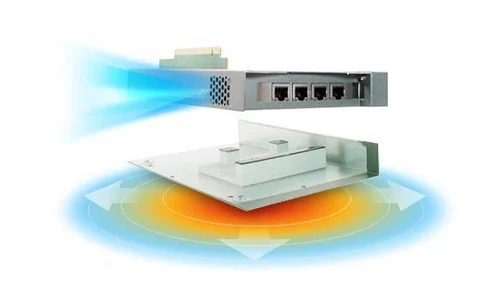
Temperature ratings
Manufacturers publish an operating temperature range for each model: the range of surrounding air temperature in which the computer is specified to run. The two ends of the range present different problems. Cold affects start-up, displays, batteries and storage. Heat limits processor performance and shortens component life.
| Range | Range (°F) | Typical environment |
|---|---|---|
| 0 °C to 40 °C | 32 °F to 104 °F | Climate-controlled indoor spaces; many fan-cooled embedded PCs |
| −20 °C to 60 °C | −4 °F to 140 °F | Factory floors, warehouses, unheated indoor spaces |
| −25 °C to 70 °C | −13 °F to 158 °F | Vehicles and outdoor enclosures in temperate climates |
| −40 °C to 70 °C | −40 °F to 158 °F | Outdoor and cold-climate installations, rail, mobile equipment |
| −40 °C to 85 °C | −40 °F to 185 °F | Matches the industrial component grade; usually limited to low-power designs |
Common ratings convert to Fahrenheit as follows: −40 °C = −40 °F, −25 °C = −13 °F, −20 °C = −4 °F, 0 °C = 32 °F, 60 °C = 140 °F, 70 °C = 158 °F, 85 °C = 185 °F.
Rail temperature classes
EN 50155, the European standard for electronic equipment on rolling stock, defines operating temperature classes that are widely used to specify rail computers.[1] Class OT3 is commonly specified for equipment mounted in technical cabinets.
| Class | Range | Range (°F) |
|---|---|---|
| OT1 | −25 °C to 55 °C | −13 °F to 131 °F |
| OT2 | −40 °C to 55 °C | −40 °F to 131 °F |
| OT3 | −25 °C to 70 °C | −13 °F to 158 °F |
| OT4 | −40 °C to 70 °C | −40 °F to 158 °F |
| OT5 | −25 °C to 85 °C | −13 °F to 185 °F |
| OT6 | −40 °C to 85 °C | −40 °F to 185 °F |
Design
A wide-temperature rating results from design choices across the whole system rather than from any single component.
Fanless cooling
Main article: Fanless industrial PCs
The processor and other hot components are thermally coupled to the chassis, which is machined with fins and acts as the heatsink. With no fan, there is no moving part to seize in the cold or clog with dust, and no air is drawn through the enclosure.
Processor power
Heat output limits the high end of the rating. Many wide-temperature systems use low-power processors, commonly with a thermal design power (TDP) of 6 W to 35 W. Systems with higher-power processors may carry a narrower rating, or a rating that depends on which processor is installed.
Components
Electronic components are sold in temperature grades. Commercial-grade parts are typically rated 0 °C to 70 °C; industrial-grade parts are typically rated −40 °C to 85 °C. Wide-temperature designs use industrial-grade capacitors, power circuitry and other onboard parts so that the whole board is rated for the full range.
Memory and storage
The rating of a complete system depends on its memory and storage also being rated for that range. Industrial memory modules and solid-state drives are available in wide-temperature versions. A consumer SSD installed in a wide-temperature chassis can become the component that fails first.
Cold start
Some designs address low-temperature start-up specifically, for example with heating elements or circuitry that delays boot until internal components reach a safe temperature.
Testing
Manufacturers validate ratings in thermal chambers. Datasheets commonly cite IEC 60068-2-1 (cold), IEC 60068-2-2 (dry heat) and IEC 60068-2-14 (change of temperature) as test methods.[2] Equipment for defense applications is often tested to MIL-STD-810 Method 501 (high temperature) and Method 502 (low temperature).[3] A datasheet's mention of a standard does not always state whether the unit was tested powered on, under what load, or for how long.
Limitations of the rating
- Operating vs. storage temperature – operating temperature is where the unit runs. Storage temperature, often −40 °C to 85 °C, is only where it survives while powered off.
- Configuration – ratings may be stated for a specific processor, with airflow, or with wide-temperature memory and storage installed. Datasheet footnotes give the conditions.
- Ambient temperature – the rating refers to the air around the computer. Inside a sealed cabinet in direct sun, that air can be much hotter than the outdoor temperature.
- Performance at the limits – near the top of the range a processor may throttle, reducing its clock speed to stay within safe temperatures. A unit can be within its rating and still run slower than at room temperature.
- Humidity and condensation – temperature ratings are separate from humidity ratings, which are usually stated as a non-condensing range. Moving equipment between cold and warm air can cause condensation inside the enclosure.
Specifying a system
- Measure or estimate the highest and lowest air temperature at the computer's actual location, including inside its enclosure.
- Read the conditions attached to the rating: processor, load, airflow and installed components.
- Confirm that memory, storage, displays and peripherals are rated for the same range.
- Allow for reduced processor performance near the top of the range.
- Check the storage temperature range for shipping and warehousing, not only the operating range.
Applications
- In-vehicle computing – fleet telematics, mining and agricultural equipment, transit
- Outdoor cabinets – traffic and roadside systems, utility substations, EV charging
- Factory and process control – foundries, cold storage, food processing
- Rail – wayside and onboard systems
- Machine vision and edge AI – in unconditioned spaces
Frequently asked questions
What is a wide-temperature industrial PC?
A wide-temperature industrial PC is a computer rated to operate in ambient temperatures well outside the range of an office PC, commonly −20 °C to 60 °C and as wide as −40 °C to 70 °C. Most are fanless box PCs that conduct heat through the chassis.
What temperature range can an ordinary office PC handle?
Office desktops and laptops are typically rated to operate between about 10 °C and 35 °C. Wide-temperature industrial PCs extend that range in both directions.
What is the difference between operating and storage temperature?
Operating temperature is the ambient range in which the computer is specified to run. Storage temperature is the wider range it can survive while powered off. A storage rating does not mean the computer will boot or run at that temperature.
Does a wide-temperature PC run at full speed at its maximum rated temperature?
Not necessarily. Near the top of its range, a processor may throttle, reducing its clock speed to stay within safe limits. The rating means the system keeps operating, not that performance is unchanged.
Do memory and storage need their own temperature rating?
Yes. A system's rating usually assumes memory and storage rated for the same range. A consumer SSD may fail below 0 °C even in a computer rated to −40 °C.
What does EN 50155 class OT4 mean?
OT4 is an operating temperature class in EN 50155, the European standard for electronic equipment on rail vehicles. It covers −40 °C to 70 °C.
See also
- Industrial computers: reference guide
- Fanless industrial PCs
- Thermal throttling
- Wide-range DC input
- EN 50155
- IEC 60068
References
- EN 50155:2017, Railway applications – Rolling stock – Electronic equipment. CENELEC.
- IEC 60068-2-1 (Test A: Cold), IEC 60068-2-2 (Test B: Dry heat) and IEC 60068-2-14 (Test N: Change of temperature), from IEC 60068, Environmental testing. International Electrotechnical Commission.
- MIL-STD-810H, Environmental Engineering Considerations and Laboratory Tests, Methods 501.7 (High Temperature) and 502.7 (Low Temperature). U.S. Department of Defense.