

Wide-range DC input
| Purpose | Run one computer from several DC supply voltages |
|---|---|
| Common ranges | 9–36 V; 9–48 V; 8–48 V; wider for rail |
| Covers | 12 V and 24 V vehicles; 24 V control cabinets; some 48 V systems |
| Typical connector | Pluggable terminal block (+, −, ignition) |
| Common protections | Reverse polarity, overvoltage, overcurrent, transient suppression |
| Related standards | ISO 16750-2, ISO 7637-2, MIL-STD-1275, EN 50155 |
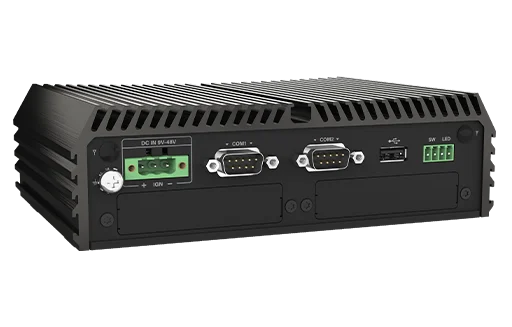
Wide-range DC input is a power input that accepts a broad span of direct-current voltages, such as 9 V to 48 V, instead of a single fixed voltage. It lets one industrial computer run directly from 12 V or 24 V vehicle power, 24 V control-cabinet power, or other DC sources, without a separate power converter.
A wide input range also lets the computer ride through the dips and surges that occur on vehicle and industrial power systems, such as the voltage drop while an engine is cranking.
Why wide-range input is used
Office computers run from AC mains through a power supply that delivers a few fixed internal voltages. Industrial computers are often installed where only DC power is available, and that power is rarely steady:
- Vehicles use 12 V or 24 V electrical systems whose actual voltage varies with battery charge, alternator output and engine starting.
- Control cabinets in factory automation commonly distribute 24 V DC control power.
- Telecom and some data equipment use 48 V DC.
- Rail vehicles use nominal voltages from 24 V to 110 V DC.
A single wide-range input lets the same computer model be installed in all of these without a model change or an external converter.
Common input ranges
| Input range | Covers nominal systems | Typical use |
|---|---|---|
| 12 V fixed (±10%) | 12 V regulated supply | Low-cost embedded PCs powered by an AC adapter |
| 9–36 V | 12 V, 24 V | Vehicles and control cabinets |
| 8–48 V or 9–48 V | 12 V, 24 V, some 36 V and 48 V | General industrial and in-vehicle computers |
| 16.8–137.5 V | 24 V to 110 V (EN 50155) | Rail computers, often via a dedicated power module |
The width of the range matters at both ends. The low end determines whether the computer keeps running during voltage dips. The high end determines how much surge headroom it has on a 24 V system and whether it can run from 48 V at all.
Vehicle power
Vehicle electrical systems are among the hardest power sources for electronics. ISO 16750-2 defines the electrical conditions road-vehicle equipment must withstand.[1] Key effects include:
- Cranking dip – starting the engine can pull a 12 V system as low as about 6 V in cold conditions. A computer that must stay on through engine starts needs an input range that reaches low enough, or holdup energy to ride through the dip.
- Load dump – disconnecting the battery while the alternator is charging produces a surge that can exceed 35 V on a 12 V system.
- Transients – switching inductive loads such as motors and relays creates short voltage spikes. ISO 7637-2 defines test pulses for these.[2]
- Reverse polarity – incorrect battery connection or jump starting can apply reversed voltage.
Military ground vehicles use 28 V systems specified by MIL-STD-1275, which includes surges of up to 100 V and spikes of up to 250 V.[3] Equipment for these vehicles often uses a separate power conditioner rather than relying on the computer's own input.
Ignition power control
Main article: Ignition power control
In-vehicle computers commonly add an ignition sense input alongside the DC input. The computer starts when the ignition turns on and shuts down in an orderly way after a configurable delay when it turns off, preventing both data loss and battery drain.
Rail power
EN 50155 specifies power supply conditions for electronic equipment on rolling stock.[4] Nominal voltages include 24, 48, 72, 96 and 110 V DC. Equipment must operate continuously from 0.7 to 1.25 times the nominal voltage and tolerate short variations from 0.6 times nominal for 100 ms to 1.4 times nominal for one second.
| Nominal | Continuous (0.7–1.25 × nominal) | Short dip (0.6 ×, 100 ms) | Short surge (1.4 ×, 1 s) |
|---|---|---|---|
| 24 V | 16.8–30 V | 14.4 V | 33.6 V |
| 48 V | 33.6–60 V | 28.8 V | 67.2 V |
| 72 V | 50.4–90 V | 43.2 V | 100.8 V |
| 110 V | 77–137.5 V | 66 V | 154 V |
Protection features
- Reverse polarity protection – prevents damage if positive and negative are swapped.
- Overvoltage protection – shuts down or clamps the input above the rated maximum.
- Overcurrent protection – a fuse or electronic current limit.
- Transient suppression – components such as TVS diodes absorb short spikes.
- Input isolation – some power inputs are galvanically isolated from the computer's ground, which helps in systems with ground loops or noisy power. Many wide-range inputs are not isolated, so datasheets should be checked.
Wiring and power budget
A computer draws roughly constant power, so the current it draws rises as the supply voltage falls. A 60 W system draws about 2.5 A at 24 V but about 5 A at 12 V, and more during a voltage dip. Wire gauge, fuses and the supply should be sized for the lowest expected voltage, not the nominal voltage. Peripherals powered by the computer, such as PoE cameras or USB devices, add to the total.
Most wide-range inputs use a pluggable screw or spring-clamp terminal block, which holds wires securely under vibration. Many computers also have a fixed-voltage barrel jack for use with an AC adapter.
Specifying a system
- Identify the nominal supply voltage and its realistic minimum and maximum, including dips during engine starting.
- Choose an input range that covers that span with margin at both ends.
- For vehicles, check whether the computer must stay on during cranking, and whether ignition power control is needed.
- Check the protections listed on the datasheet, and whether the input is isolated.
- Size wiring and fusing for the maximum current at the lowest voltage, including powered peripherals.
- For rail or military vehicles, confirm compliance with EN 50155 or MIL-STD-1275 rather than relying on input range alone.
Frequently asked questions
What does wide-range DC input mean?
It means a computer accepts a broad range of DC supply voltages, such as 9 V to 48 V, instead of one fixed voltage. The same computer can then run from 12 V or 24 V power without a converter.
Can a 9–36 V computer run on a 12 V vehicle?
Yes, at normal operating voltage. During engine cranking, a 12 V system can drop below 9 V, so the computer may reset unless it has holdup capacity or is powered through ignition control that keeps it off during starting.
Can a 9–36 V computer run on 48 V?
No. 48 V exceeds the 36 V maximum. A computer for 48 V systems needs an input range that extends above 48 V with margin, or an external DC-DC converter.
What is load dump?
Load dump is a voltage surge that occurs when a vehicle battery is disconnected while the alternator is charging it. With the battery no longer absorbing the alternator's output, the system voltage can briefly exceed 35 V on a 12 V system.
Why does a computer draw more current at lower voltage?
A computer needs roughly the same power regardless of supply voltage. Since power equals voltage times current, halving the voltage roughly doubles the current. Wiring and fuses must be sized for the lowest voltage the system will see.
Is a wide-range input the same as an isolated input?
No. Wide-range describes the voltages accepted. Isolation means the input is electrically separated from the computer's internal ground. A wide-range input may or may not be isolated.
See also
- Industrial computers
- Ignition power control
- EN 50155
- MIL-STD-1275
- Power over Ethernet (PoE) in industrial PCs
References
- ISO 16750-2, Road vehicles – Environmental conditions and testing for electrical and electronic equipment – Part 2: Electrical loads. International Organization for Standardization.
- ISO 7637-2, Road vehicles – Electrical disturbances from conduction and coupling – Part 2: Electrical transient conduction along supply lines only. International Organization for Standardization.
- MIL-STD-1275E, Characteristics of 28 Volt DC Input Power to Utilization Equipment in Military Vehicles. U.S. Department of Defense.
- EN 50155:2017, Railway applications – Rolling stock – Electronic equipment. CENELEC.