

Industrial Computers
| Also called | Industrial PC, IPC, embedded computer, box PC, rugged computer |
|---|---|
| Typical cooling | Fanless conduction through the chassis |
| Typical temperature range | −20 °C to 60 °C; up to −40 °C to 70 °C |
| Typical power input | Wide-range DC, e.g. 9–48 V |
| Common processors | Intel Core, Intel Atom and N-series, AMD Ryzen Embedded, Arm |
| Operating systems | Windows IoT Enterprise, Linux |
| Common standards | IEC 60068, MIL-STD-810, EN 50155, UNECE R10 (E-Mark), UL |
An industrial computer (industrial PC, or IPC) is a computer engineered to run continuously in harsh environments: extreme temperatures, vibration, dust, moisture and unstable power. Industrial computers control machinery, collect data from sensors, run operator displays and process camera feeds in factories, vehicles, rail systems, utilities and outdoor installations.
Most industrial computers use the same x86 processors and operating systems as office PCs. They differ in how they are cooled, powered, mounted, connected and certified, and in how long each model remains available.
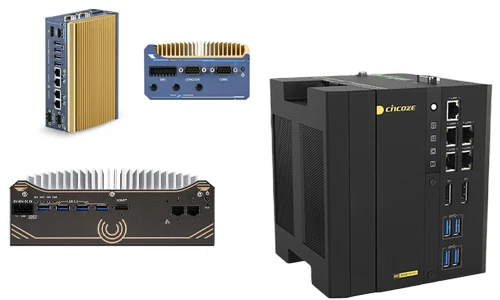
Industrial vs. commercial PCs
Industrial PCs differ from commercial desktop PCs in how they are cooled, powered, mounted and certified.
| Attribute | Commercial desktop PC | Industrial PC |
|---|---|---|
| Operating temperature | About 10 °C to 35 °C | Commonly −20 °C to 60 °C; up to −40 °C to 70 °C |
| Cooling | One or more fans | Usually fanless |
| Power input | AC mains via internal or external supply | Wide-range DC; optional AC adapter |
| Shock and vibration | Not specified for operation | Rated and tested, e.g. to IEC 60068 or MIL-STD-810 |
| Mounting | Desk or tower | Wall, DIN rail, VESA, vehicle frame, rack |
| I/O | USB, video, Ethernet | Adds serial (RS-232/422/485), digital I/O, CAN, PoE, multiple Ethernet ports |
| Product life | Models change frequently | Same model typically available for several years |
| Certifications | Consumer safety and EMC | May add UL, EN 50155, E-Mark, marine and hazardous-location approvals |
Form factors
- Box PC (embedded computer) – a compact, sealed computer with no display, mounted near the equipment it controls. The most common industrial form factor.
- Panel PC – a computer integrated with a touchscreen, used as an operator interface (HMI) on machines and cabinets.
- Rugged tablet – a portable computer built to survive drops, water and temperature extremes.
- Rackmount industrial PC – a 19-inch rack server or workstation built with industrial components for control rooms and network cabinets.
- GPU and edge AI computer – a computer with a discrete GPU or AI accelerator for machine vision and on-site inference.
Defining features
Fanless cooling
Main article: Fanless industrial PCs
Most industrial PCs have no fan. The processor transfers heat into a finned metal enclosure, removing the most common moving-part failure and keeping dust out.
Wide operating temperature
Main article: Wide-temperature industrial PCs
Industrial PCs are rated to run without climate control. Common ratings are −20 °C to 60 °C and −25 °C to 70 °C, and many models are rated from −40 °C.
Wide-range DC power and ignition control
Main articles: Wide-range DC input, Ignition power control
A wide-range DC input lets one computer run on 12 V or 24 V power. In-vehicle models add ignition power control, which starts and shuts down the computer from the vehicle's ignition signal.
Industrial I/O
Serial ports, isolated digital I/O, CAN bus, multiple Ethernet ports and Power over Ethernet connect the computer directly to sensors, cameras, programmable logic controllers (PLCs) and vehicle networks.
Modular expansion
Main article: Modular I/O expansion
Many manufacturers offer modular I/O systems that add application-specific ports, such as extra serial, CAN or PoE ports, through a mezzanine board or expansion module rather than a custom design. Standard expansion slots (PCIe, M.2 and mini PCIe) are also common.
Long product life
Industrial computers are usually built on processors from manufacturers' embedded roadmaps, which remain in production longer than consumer parts. This lets equipment builders certify a system once and keep shipping the same hardware for several years.
Processor platforms
The processor platform sets performance, power draw and, in a fanless chassis, the practical upper temperature limit.
| Platform | Typical power class | Typical use |
|---|---|---|
| Intel Atom x6000E | About 5–12 W | Ultra-compact, low-power embedded control and gateways |
| Intel N-series (e.g. N97, i3-N305) | About 6–15 W | Low-power gateways, HMI and light edge computing |
| Intel Core mobile (U-series) | About 15 W | Efficient general-purpose computing in compact fanless chassis |
| Intel Core desktop (10th–14th Gen) | 35–65 W | High-performance control, vision and multi-camera systems |
| Intel Core Ultra 200S | 35–65 W | Newest desktop-class platform with an integrated NPU; AI-capable edge workloads |
| AMD Ryzen Embedded | About 6–54 W | Graphics-heavy displays, signage and general embedded computing |
| Arm (e.g. NVIDIA Jetson, NXP i.MX) | About 5–60 W | Edge AI inference (Jetson); low-power control and HMI (i.MX) |
Power classes are approximate; each processor model has its own thermal design power (TDP), and some can be configured up or down.
Topics
Form factors
- Box PCs
- Panel PCs
- Rugged tablets
- Rackmount industrial PCs
- GPU and edge AI computers
Environmental ratings
- Wide-temperature industrial PCs
- Fanless industrial PCs
- Shock and vibration ratings
- IP ratings for industrial computers
Power
- Wide-range DC input
- Ignition power control
- Power over Ethernet (PoE) in industrial PCs
Certifications and standards
- UL certification for industrial PCs
- EN 50155
- E-Mark
- MIL-STD-810
- IEC 60068
Platforms and I/O
- Intel Core Ultra 200S industrial PCs
- Modular I/O expansion
- Serial ports: RS-232, RS-422, RS-485
- CAN bus
Glossary
- Box PC
- A self-contained industrial computer in a compact rectangular chassis without a built-in display. Also called an embedded PC.
- CAN bus
- Controller Area Network, a serial bus used in vehicles and machinery for communication between controllers.
- DIN rail
- A standardized 35 mm metal rail used to mount equipment inside control cabinets.
- E-Mark
- European type approval for electronic equipment installed in road vehicles, issued under UNECE Regulation No. 10 (electromagnetic compatibility).
- EN 50155
- European standard for electronic equipment used on rolling stock (railway vehicles).
- HMI
- Human–machine interface, the display and controls an operator uses to monitor and run equipment.
- Ignition power control
- A feature that turns an in-vehicle PC on and off from the vehicle's ignition signal, with configurable delays to prevent battery drain and allow a safe shutdown.
- Mezzanine I/O module
- A small board that stacks onto a computer's main board to add application-specific ports without changing the main design.
- Operating temperature
- The ambient temperature range within which a computer is specified to run.
- PoE / PoE+ / PoE++
- Power over Ethernet. IEEE 802.3af supplies up to 15.4 W per port, 802.3at (PoE+) up to 30 W, and 802.3bt (PoE++) up to 60 W or 90 W, measured at the source. Industrial PCs use it to power cameras and sensors.
- TDP
- Thermal design power, the sustained heat output a processor's cooling must handle, in watts.
- Wide-range DC input
- A power input that accepts a broad DC voltage span, such as 9 V to 48 V, so one computer can run on 12 V and 24 V vehicle or cabinet power.
Frequently asked questions
What is an industrial PC?
An industrial PC (IPC) is a computer built to run continuously in environments that would damage or shut down a commercial PC: extreme temperatures, vibration, dust, moisture and unstable power. Most are compact fanless box PCs that run standard operating systems such as Windows IoT and Linux.
What is the difference between an industrial PC and a regular PC?
Industrial PCs use components rated for wider temperature ranges and longer service life, accept wide-range DC power, mount to walls, DIN rails or vehicle frames, and offer industrial I/O such as serial ports, digital I/O, CAN bus and multiple Ethernet ports. Commercial PCs are designed for climate-controlled offices and change models frequently.
How long is an industrial PC available for purchase?
Industrial PC models are typically sold for several years, often five or more, while many consumer models are replaced within one to two years. Long availability lets equipment builders certify a system once and keep shipping the same hardware.
What is a fanless PC?
A fanless PC has no cooling fan. Heat is conducted from the processor into a finned metal chassis that works as a heatsink. Removing the fan eliminates a common failure point and keeps dust from being pulled into the computer.
What operating systems do industrial PCs run?
Most x86 industrial PCs run Windows 10 or 11 IoT Enterprise or Linux distributions such as Ubuntu. Edge AI systems based on NVIDIA Jetson run NVIDIA's Linux-based JetPack software.
Can an industrial PC run AI workloads?
Yes. Industrial PCs run AI inference on the processor's integrated graphics or neural processing unit (NPU), on a dedicated module such as NVIDIA Jetson, or on a discrete GPU installed in a larger chassis. Inference at the edge avoids sending camera or sensor data to a remote server.
See also
- Wide-temperature industrial PCs
- Fanless industrial PCs
- Box PCs
- Panel PCs